Saturday, April 21, 2007

Caving near Grassy Cove

What a beautiful day we had on Saturday!

One day earlier in the week, Gary called and said that he heard about a land dedication event on Saturday and wanted to know if I wanted to go. The event was to thank 2 landowners who donated a total of 350 acres on Brady Mountain for the Cumberland Trail. We wanted to attend because, after the speeches, a Tennessee Parks Ranger was going to lead a hike to, and into, a cave.

So Gary, Ray, and I headed off. We didn't know what to expect. Gary volunteers often on the Cumberland Trail and he is a member of the Tennessee Trails Association. We figured that there would be some TTA members and maybe some local government officials. We heard that there would be some food. We didn't know if there would be 6 or 60 people there.

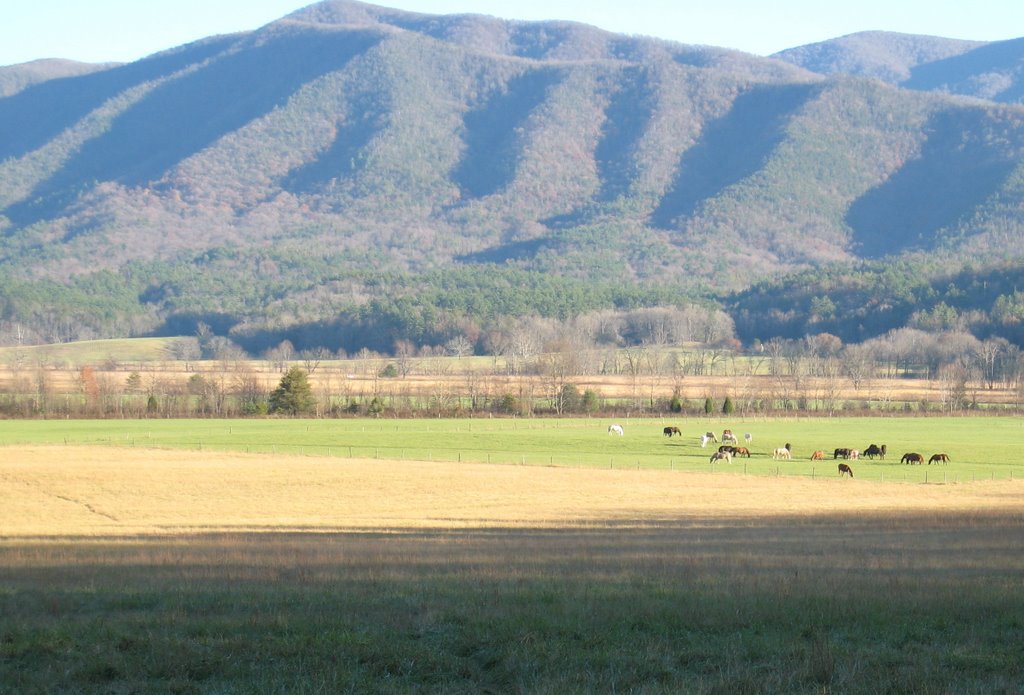
The event was held in Grassy Cove. Grassy Cove is a beautiful valley surrounded by mountains. It is 3 miles by 8 miles in size and consists of beautiful green fields, horses, farms and a few scattered homes. The valley is and always has been owned by one extended family. The picture above is an example of what the whole valley looks like.

Believe it or not, the dedication event was fantastic. First of all, there were about 200 people there....not usually my kind of event. But, at one point, Gary, Ray and I looked at each other and said, "does it get any better than this?". There we were in a beautiful outdoor setting, surrounded by mountains, listening to a local mountain music band, eating freshly cooked and baked food from the local people, and drinking, wine, Guinness, and Sam Adams....all for free. We determined that no one in Grassy Cove ever had a problem with stress.

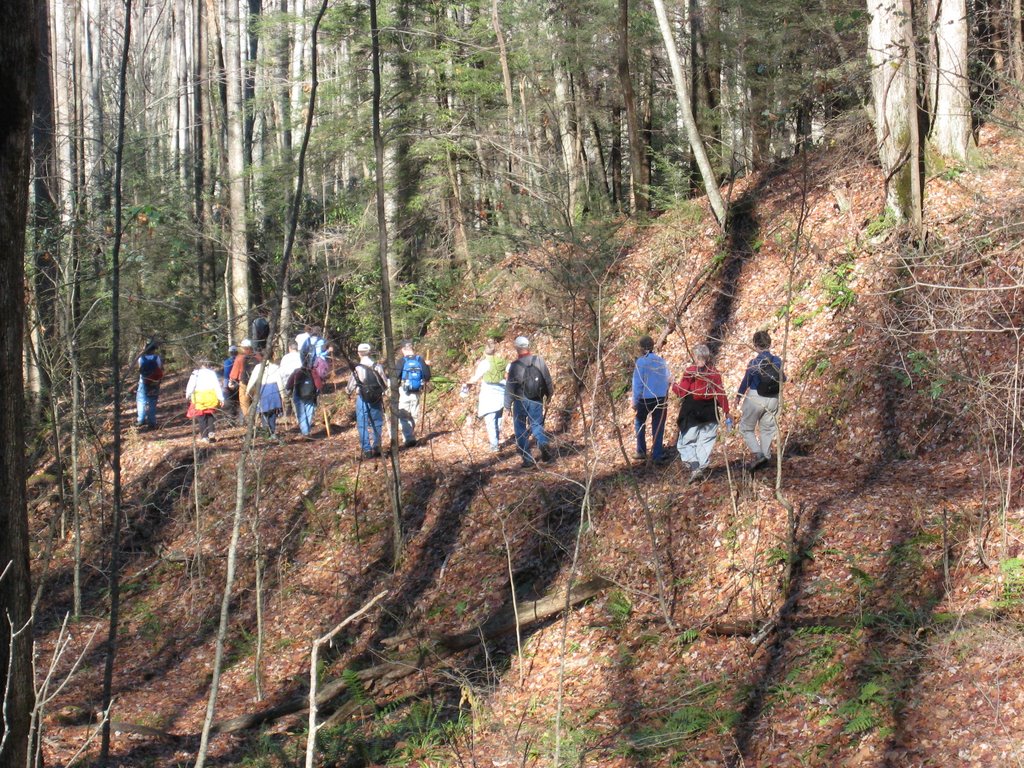
After about an hour of speeches, music, beer and food we followed a Ranger about a half mile through the woods to Saltpeter Cave. This cave was used during the Civil War to mine saltpeter which is a key component of gunpowder. I am not sure if it was used by the North or the South, since although Tennessee was part of the Confederate States, eastern Tennessee was mostly in support of the Union.

We had to squeeze through the very small opening to the cave. But once inside it opened up into several very large high rooms. We followed the Ranger a couple of hundred yards through several passages and rooms in the cave. Although it was 75 degrees outside, it was only about 55 inside.
The picture to the left is in the first big room looking back toward the opening. Above the heads you can see the light from the small opening. The flash from the camera lit up this scene, but without the flash it was obviously very dark with only flashlights lighting a small area in front of each person. Notice the unnamed person in the white hard hat (could that be Ray?) wearing sunglasses inside the cave. For 20 minutes he thought that his flashlight was about out of batteries until someone happened to shine their light on him and see the sunglasses. Dang, these caves are dark!

Well that was the Saturday entertainment in Grassy Cove and Saltpeter Cave. What started out as an unknown turned into a pretty darn nice time.

Monday, April 09, 2007

The Beautiful Smoky Mountains

Anytime we head east, I can't wait until the Smoky Mountains come into view. It makes me smile the second I see them in the distance.

Nancy and I went to Gatlinburg last Saturday to stay overnight and then to go to an outdoor Easter Sunrise service at the top of Ober Gatlinburg, the ski mountain. There was a free Tram (cable car) ride from downtown to the ski area for the service which started at 6:30 am. It was dark and cold (about 25 degrees) but we wore our ski jackets and pants and were quite toasty. The sun came up behind the mountains as the service progressed. It was a very nice way to celebrate Easter, and I would guess we will do it again.

There is nothing more beautiful than being in the mountains and the Smoky Mountains are a real gem. After the Easter service we drove the Roaring Fork Motor Trail and then up to Newfound Gap and to Clingman's Dome. There was snow from Newfound Gap on up, but sunny and not too cold.

We continued on to Cades Cove for a 5 mile hike to Abrams Falls and back. Cades Cove is at a relatively low elevation and everything was green and snow free. We hiked with fleece vests but no jackets.

I have an interesting little story that happened on the hike. About an hour into the 2-3 hour hike I realized that I had left my $350 GPS on top on the car roof in the gravel parking lot with about 30 cars and many people around. After calmly saying "stupid, stupid, stupid" out loud I had nothing to do at that point but continue on the hike. A few minutes later we met a couple on the trail heading back toward the parking lot, an hour away. I asked the man that if my GPS was by any chance still on the roof top if he would place it under my car by the rear wheel to put it out of sight. When we returned to the car almost 2 hours after that there was a note on my windshield. It read "Check before driving off". Under my car was my GPS, still on. Believe it or not, I really had a positive feeling that it would be there. It is enough to restore your faith in human goodness.
If you haven't visited the Smoky Mountains recently, get there soon. Try to avoid July & August (prime vacation time), and October (leaf peepers) if you want to miss the most crowded times. The Great Smoky Mountains National Park has no entrance fee and no commercialization. Gatlinburg is a tourist zoo, but the National Park is all natural. The park is great for hiking, fishing, wildlife spotting, or even just listening to the sounds. We just wish it was 30 minutes away instead of 90. That way we could visit more often and we could smile at those mountains every day.

Thursday, March 29, 2007

Well hello there!

"Hello there!" That is what Mr. Black Rat Snake said to Nancy as she was leading a hike last Monday.

We were doing a pre-hike to scout an upcoming Fairfield Glade Hiking Club trip that Ray and Marion are leading. Nancy was in the lead with 3 of us behind her when I heard a gasp. Mr. Snake was lying beside the trail to greet us. Black Rat snakes (sometimes called Eastern Rat Snakes) can be up to 5 feet long. This one was about 4 feet long....approximately the same distance that Nancy jumped back.

These are good snakes. They eat mice and birds by constricting them first. They climb well and I suspect that it was one of these guys that got the bluebird eggs in our nest box last year. Well, generally they are good snakes.

We used to catch one from time to time in Pennsylvania when we were kids and let them wrap themselves all the way up our arms. It was a good trick for casually walking into the cottage and scaring the womenfolk.

Black Rat Snakes are sometimes (and easily) confused with Black Racers (often called Eastern Racers). Black Rat Snakes look all black at first, but as you can see in this photo, in the right light they have lighter scales that give them a pattern. It is usually not as evident as in this picture.

Black Racers, on the other hand, are completely satiny black on the top. Full sized Black Racers are slightly smaller at only about 4 feet long. Also, Black Racers hold their head high when moving rapidly across the ground. Neither snake is venomous but both will bite if handled, especially the Black Racers. Both snakes are found east of the Mississippi from New England to Florida.

So the next time a black snake says "hello" to you try to determine if it is a Black Rat Snake or a Black Racer. Then you will be able to give the proper greeting in response.

Thursday, March 15, 2007

What a Week!

Wow, what a week! What hard work! What fun!

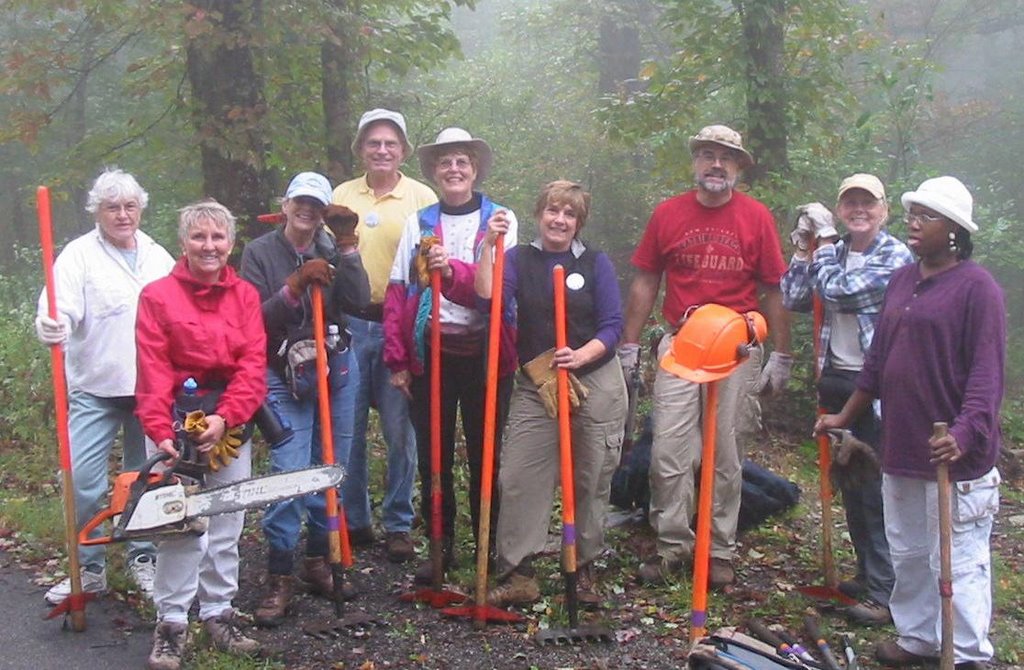
Gary Ruetenik (in the orange shirt) likes to build hiking trails. Gary is a volunteer crew leader or "Wagon Master" who asked if I wanted to help build a section of the Cumberland Trail which will eventually traverse Tennessee from Kentucky to Georgia. About 150 of the 300 miles of trail is finished...all by volunteers. I agreed to help but didn't know how hard the work was...or how much fun.

The fun part was working with 49 great college kids who gave up their spring break time to volunteer and help build the trail. Heck, they came to help Tennessee and they all came from other states. 10-15 students each came from 4 colleges....Longwood University in Virginia, Cazenovia college in NY, Hamilton College in NY, and the University of Wisconsin at River Falls. There were over 100 more students working on another part of the trail. There will be more next week.

I worked all week with the self named "Hard Core Crew" from Longwood University; 9 young women and one young man. They were all hard working, smart, and with the best positive attitudes that you could ask for.

Trust me, it was hard work. The first two days I could hardly get out of the car when I got home. I am not kidding. I either got in better shape or got numb as the week went on because I felt that I worked harder and was less tired each day. But here is an interesting piece of information....my elbow tendonitis and Ray's sore back got better the more we worked.

And how did the trail work go? Well, the guys like Gary who do this regularly said that these were the best crews that they ever had. We completed far more trail than the target for the week and the technical aspects of the trail, such as proper slope, proper drainage, elimination of roots and rocks, safe stone steps, etc., were all perfect.
Here is the whole crew cleaned up and looking good (click on the picture for a larger view).

For more pictures from our week of trail building go to this Picasa Web Album.

There will be many more opportunities to volunteer for this hard work and fun time. Contact me and I will put you in touch with Gary Ruetenik. You can work one day or many, your choice. I can only guarantee that you will feel much better (in many ways) after building trail with a bunch of positive young college students like these.

Saturday, March 10, 2007

You outta see this animal


Slowly but steadily I have been checking off my list of local animals to see. I got another one in the last week....twice. The cute little furbearer in the photo here is a Northern River Otter. These guys once inhabited most of the continental U.S. But like others, they were hunted, trapped and squeezed out of available habitat by their main predator....man (including woman I'm sure).

In many parts of the U.S. they have been reintroduced, waterway by waterway....including Tennessee.

I saw this guy (or girl) while fishing on the Caney Fork River a week ago, but I didn't have my camera. I went fishing again a couple of days ago and specifically took my camera just in case I saw him again. I didn't take my big camera with the telephoto lens because I was afraid that if I slipped in the stream that the camera would be drowned. So I put my smaller camera in a double zip lock bag in my fishing vest. I might survive a dunking in 40 degree water, but I am sure that a camera wouldn't. Sure enough I saw him again in just about the same spot along the shore. I had to blow up the picture quite a bit so it isn't crystal clear, but it is about as good as I expected to get of a wild otter.

Otters are about 3-4 feet long including their tail which is about one third of that, so they are much larger than their cousins, weasels, mink, and skunks. They are generally solitary animals except for mothers with young. They primarily eat fish and crayfish. Sources that I have read say they eat mostly non-game fish like suckers, but I am sure that trout are also on their menu.

River otter...check mark. Now if I can only get a picture of red and grey foxes, bobcats, and wild boar.

Sunday, February 18, 2007

Woodpeckers

I recently was able to get some close-up pictures of 3 of our common local woodpeckers. The beautiful bird in this picture is a Hairy Woodpecker. We see these less frequently than the others pictured below. They look almost exactly like a Downy Woodpecker but they are bigger (about 9" versus 6") and they have a much longer bill than the Downys.
This bird and the others below are all on the new suet logs that I made. The logs are hanging right off of my deck and they have attracted so far, 3 kinds of woodpeckers, nuthatches, and bluebirds. There is usually very few 15 minute intervals during the day when one of these birds is not on the suet log.

Now here, on the left, is a little female Downy Woodpecker. These are the most common woodpeckers that we see around here. They are somewhere in the backyard or in the woods visible from the house almost all day long. There is one out the window eating suet right now as I am typing this. The Downys and the Bluebirds are often both on the same feeder at the same time. Downys are the smallest woodpecker and they have a short little bill for a woodpecker.

This one is a Red-Bellied Woodpecker. You may be asking, like my neighbor Ed, where is the red belly. Well, it is often very hard to spot. But you can sometimes see the faint red if they are sitting just right. You can't see it in this picture. Red-Bellied woodpeckers are about the same size as the Hairy Woodpeckers...about 9".

There are 2 other kinds of woodpeckers that we see quite often (once a week or so) but that I haven't been able to get a close picture yet. One is the Red-Headed Woodpecker whose whole head is red. The other is the Pileated Woodpecker. The Pileated is the giant woodpecker about 18" high, or double the size of any of the others.
This guy on the wooden suet feeder to the left is a Yellow-Bellied Sapsucker. Although we supposedly have them around here, I haven't seen one yet. This picture was taken by our friend and famous wildlife photographer, Joe Burkett of Pottsboro Texas. The Yellow-Bellied Sapsucker is about 8" tall, bigger than a Downy but smaller than a Hairy or Red-Bellied.

Put a suet log or suet feeder out your back window and you too will soon have woodpeckers visiting your yard.

Sunday, February 11, 2007

Cumberland Trail

Looks like just a ribbon on a tree, right? Well what you are looking at is a future section of the Cumberland Trail that when finished will traverse Tennessee from Kentucky to Georgia.

On Saturday I was fortunate to get to go with 4 other folks responsible for the completion of the Cumberland Trail. The trail will eventually be about 300 miles long. Currently it is about half finished.

Most of the actual work on the trail is by volunteers. In March several hundred college students will give up their Panama spring break (or wherever they go these days) to volunteer for manual labor on the Cumberland Trail.

Cumberland Trail Program Coordinator Tony Hook led the 4 of us to the Royal Blue Wildlife Management area to flag about 1 1/2 miles of trail. Flagging involves figuring out exactly where the trail will be built and marking the trees with ribbons. Sometimes the decision is easy. Sometimes it involves walking and re-walking an area to try to determine the best route for the trail to follow. We had to take into consideration steepness, erosion potential, possible wet areas after rain, switchback locations, ease of construction, etc., etc.
In the picture to the left are my 4 companions for the day....Tony Hook, Gary Ruetenik, Carolyn Miller and Jim McCullough.

Tony is the expert. He is responsible for the trail from Kentucky to Georgia, but Gary, Carolyn and Jim know quite a bit about trail work also. I was the rookie.

The ribbons that we put on the trees will be followed by the volunteers in March with picks, shovels, McClouds, (a trail building tool) and chain saws to build the trail. Nancy and I plan to volunteer the week of March 12 to work on the trail on Black Mountain, a little closer to home.

If you go to the web site for the Cumberland Trail you can learn more, as well as see a previous photo (near the bottom of the page) that I took when the Fairfield Glade hiking club worked on Black Mountain. Nancy is in the middle of the photo with the white name badge and a McCloud in each hand.

Thursday, February 08, 2007

Suet Log

My little article in the Fairfield Glade Vista newspaper generated several email comments. Several people had specific questions about bluebirds ... some of their questions I knew the answer to, and some I had to research before responding.

Two comments were especially helpful. The first was from someone who said in addition to mealworms, raisins and cranberries, that their bluebirds regularly came to a suet log that they made. They took a piece of a tree branch a couple of feet long and drilled 1 inch holes in it which they then filled with suet. I tried it and the bluebirds were on it within an hour. The picture above shows a male bluebird on my suet log with a goldfinch looking on. The goldfinch doesn't eat from the suet feeder, it is just visiting. I think that it is important to use a branch with some type of rough bark so the birds can get a good grip. Maple or beech might be too smooth to work.

Another suggestion came from a woman who said that she makes her own suet rather than buying the commercial kind and the bluebirds seem to like it better. Well, we tried her recipe and she is right. The bluebirds preferred the home made suet. Here is the recipe in case you want to try it.
All season suet recipe.
1 cup regular or crunchy peanut butter.
2 cups of quick cook oatmeal.
2 cups of cornmeal.
1 cup of lard (no substitutes here).
1 cup of white flour.
1/3 cup of sugar.

Melt peanut butter and lard together. (use very low heat).
Stir remaining ingredients together very well.
Then mix thoroughly with peanut butter and lard.
Pour into freezer containers and refrigerate until solid.

Woodpeckers come to these suet logs also. Above is a picture of a cute little Downy Woodpecker. He had just stepped off of the suet log to sit on the deck railing for a few seconds.

The cost of a piece of tree branch - zero
The cost of a screw-in eye-hook to hang the feeder - 33 cents
The fun of watching birds 3 feet outside your window - priceless.

Monday, January 29, 2007

Coyotes in your backyard

As everyone knows from watching those old Westerns on TV, coyotes live in the southwestern United States. That is pretty much where they lived back in 1492 when Columbus arrived. But a crazy thing happened over the last 500 years….we humans wreaked havoc with nature.

One of the things we did was kill all of our competition such as Mountain Lions, Wolves, Bears, etc. These animals were the top of the food chain until firearms, traps and poison wiped out or greatly reduced them from their original range. Especially with the wolves gone from the lower 48 states, a void was left that coyotes were all too happy to fill. Wolves have since been reintroduced in Idaho, Wyoming, and Montana and there is a population in Minnesota. But in most of the eastern U.S. coyotes rushed in to fill the space where wolves once roamed.

One web site says that it was 1985 when coyotes were first confirmed in the Smoky Mountains. That is probably about the same time that they found Fairfield Glade.

Coyotes look very much like small German Shepherds. They usually weigh between 20 and 40 pounds. Supposedly, one way to tell is that coyotes travel with their tail down (not between their legs, just down) while dogs usually carry their tail up. But don’t worry too much about trying to identify them. Coyotes are rarely seen. Even living in the southwest for 15 years, I only ever saw a handful of coyotes, even though I heard them many times. However, another way to know that coyotes were in your neighborhood in Dallas was that your night roaming cat suddenly turned up missing. Coyotes love cat snacks.

Coyotes are rarely a threat to humans unless they become conditioned getting food through either garbage left out overnight or pet food left outside. Even then, they usually skedaddle at the sight of a person. The Tennessee Wildlife Resources Agency website says that in “recorded history there have only been 30 cases of coyote attacks on humans, while 30 million children are bitten by dogs each year.”

My wife Nancy and I were lucky to see two in Fairfield Glade last winter. We were walking along a back road near our house one morning about 10am when two deer ran across the road in front of us. I was curious why the deer were in such a high gear. I knew the answer when 2 coyotes appeared on the road a few minutes behind the deer. They stopped and looked at Nancy and me for 5 or 10 seconds, and then they were off. Coyotes probably don’t often catch healthy adult deer, but like all predators they will always look for a weakness. These two either knew something about the deer they were chasing or they were hoping to get lucky.

We hear a pack near us several times a week in the summer when we have our windows open at night. Sometimes we hear them twice a night, sometimes just once a week. They yip and yap more than they howl, but there is no mistake when a whole pack sounds off.

Coyotes! They are here in Fairfield Glade and just about everywhere in the U.S. even though you may never see them. Step outside at night and listen or better yet, sleep with you windows open in the summer and you just might be lucky enough to hear one of the great sounds of nature.

By the way, my chances of getting a picture of one of these elusive canids is pretty darn slim. Most of the pictures in my blog are ones that I have taken. But in this case, these pictures are ones that I found on the internet.


Tuesday, January 09, 2007

Identify this animal

If you guessed a cute dog or an ugly girl, you are way off. If you thought that this is a llama, you are wrong, but very close.

This is an alpaca. Alpacas are related to llamas, vicunas and guanacos....all camelids from South America.

Why am I writing about alpacas from South America? Well, we visited an alpaca farm in Ohio over the holidays and I found out some very interesting information about these animals.

Alpacas live naturally in Peru, Bolivia, and Chile at elevations of 10,000 to 15,000 feet above sea level. They have been imported to raise in the United States and other countries primarily as an investment. Their wool (or fiber, as it is called) can be sold and it is supposedly lighter and warmer and less itchy than sheep's wool. But the bigger market is to sell alpacas to other people hoping to raise alpacas to sell them to other people, etc., etc. It sounds a little like a pyramid scheme to me. At some point won't there be more alpacas than people wanting to buy them? And is the market for the fiber big enough to cover your costs? However, alpaca web sites claim that the market for alpacas has remained steady for 20 years.

And what is the price of a nice alpaca these days? The owner of the farm in Ohio said that males go for about $3000 and females for $9000. But on the alpaca farms websites that I found it looks like good females (good meaning having won some ribbons at an alpaca show and having nice soft fiber) go for $14,000 to $20,000. Since alpacas have babies (a baby alpaca is called a cria) once every year you could conceivably recoup your investment in a female in a year or two if her crias were female or in 5 years or so if they were all males. The guy in Ohio said that taking care of 30 alpacas is easier and less expensive than the 3 horses he used to have. He will board your alpaca for $90 per month if you don't want to shovel alpaca poop yourself.

And speaking of alpaca poop, these tidy animals all go in the same spot in the barnyard....making cleanup easier than for other large animals. Websites claim that alpacas can actually be housebroken. Although they are smaller than llamas they would still be a little big for sitting on your lap on the couch.

Male alpacas, although usually gentle with humans, have "fighting teeth" that must be trimmed to prevent damage to important male alpaca parts necessary for breeding. Ouch!

In the picture to the left is my grandson, Justin in the barnyard among about 20 alpacas. This young female named Cinnamon took a liking to Justin.

We were told that alpacas are smaller and gentler than llamas and they are much less likely to spit or regurgitate their stomach contents on you like an agitated llama has been known to do. They are too small to be used as pack animals like llamas. As you may recall from an earlier posting, llamas are used in the Smokey Mountains to deliver supplies to Mount LeConte three times a week.

We stopped at the alpaca farm because Justin had done a school report on llamas earlier. The alpaca farm visit was the highlight of his day....week....month! You too could visit an alpaca farm if it sounds interesting. There are farms all over the U.S. and several in Tennessee. These farms generally welcome your visit because you could be the next investor in a nice $20,000 bundle of fur.

Thursday, December 21, 2006

Golf Balls

My new hobby is searching for golf balls on rainy days when I have nothing better to do. There are 5 golf courses within 4 1/2 miles of my house so I am not far from easy action. I average about 1 found ball for every 2 minutes in the woods. In 2 hours I usually find 60-75. Rainy days are best because there are few on no golfers on the courses. I have all of the water proof, breathable gore-tex gear so the rain is not a problem for me. The winter is the best time of year to search because in the warm months the snakes, ticks and chiggers make it too interesting. The thickest, thorniest, steepest and rockiest places, where most people would not go, is where I find the most golf balls. But it is amazing how many balls are just out in the open right inside the woods.

Since I now have a garage full of golf balls I was trying to decide which ones I should use. After hours on the web and reading numerous articles I have come up with the following conclusions.

The best balls for you are determined largely by your swing speed. Many pro shops or anyone who makes clubs will probably have a swing speed meter. Your swing speed will also determine which clubs are best for you (but then that is another issue).

Unless you are shooting 80 or under for 18 holes (this probably doesn't include many people reading this blog) you should probably be using a 2-piece ball with below average spin and low compression. The low compression gives most of us with our less than 100 mph swing speeds greater distance, and the below average spin gives our amateur form straighter drives because of less slice or hook.

Those over $50 per dozen Titleist Pro V1’s and Nike One’s that the pros use will actually give most of us much less distance and much more slice. Unless your swing speed is over 100 and preferably 115 or greater, most of us can’t take advantage of these balls. They will actually hurt your game.

Here are the best balls to use:

Swing speed under 75 mph

Titleist DT So Lo
Maxfli Noodle
Precept Laddie
Nike Mojo
Callaway Big Bertha-red or blue

Swing Speed 75-100 mph

Titleist NXT
Nike Power Distance
Nike Power Soft
Maxfli Noodle Ice
Top Flight Quartz
Callaway Hot
Some articles say the Pinnacle Exception and Gold may be OK. Some say to avoid all Pinnacles.

Only for those with 100+ mph swing speed

Titleist ProV1
Nike One
Nike Platinum
Callaway HX Tour
Maxfli Black Max
Bridgestone B-330

Some articles say to never use Top Flight XL’s, 2000’s, or 3000’s or any Pinnacles. This is very interesting since Top Flights are the balls that I find in the woods the most…..by far. If you need some Top Flights, give me a call. Then when your Top Flight XL 2000 spins into the woods it will give me something to find on the next rainy day.

Thursday, December 07, 2006

Winter Bluebirds

If you thought that Bluebirds fly south for the winter....they don't. At least not around here, and not in Ohio either.

The bluebird at left is sitting on the edge of the bluebird feeding tray that I built to attach to our deck railing. The doggone mealworms didn't like to hang around too long waiting to get eaten and they would crawl off of the railing. This new feeding tray makes it a little harder for the little fellows to get away. We also put cut up raisins and cranberries on the tray for the bluebirds.

The first time I realized that bluebirds stay for the winter was about 5 years ago while we were in Ohio at Christmastime. I was out hiking in the snow in the woods and saw several bluebirds. When I got back to Texas after Christmas I made a couple of bluebird houses for my daughter in Ohio and she raised babies in her backyard the first summer. After some trials and tribulations with those nasty House Sparrows, she raised more bluebirds this year.

We had one pair of bluebirds raise two seperate nests of babies this year....one right after the other. Now we have up to 6 bluebirds dropping in about 2 or 3 times a day for mealworms and berries. We can't tell if our daily visitors are the parents or all just the teenagers since the babies are all grown up now and they all have their adult plumage.

Bluebirds normally eat insects in the warm months and whatever berries they can find in the cold months. It must be a real treat for them to find insects (the mealworms) this time of year. They always eat the mealworms first and then come back later for the berries.
This picture was taken into the sun so the colors don't show up very vividly, but the pose is exactly like the one in a framed picture that our next door neighbor (soon to be neighbor...house not done yet) gave us. Their picture is better, but I like the 'here's looking at you' pose.

Even though the bluebirds obviously don't nest in the winter, we keep the bluebird box up since we have read that on very cold nights as many as 8 or 10 bluebirds will crowd into a bluebird box to huddle together for warmth. With the temperature scheduled to drop to 13 tonight, this might be one of those times.

Friday, December 01, 2006

Run Bucky, run!

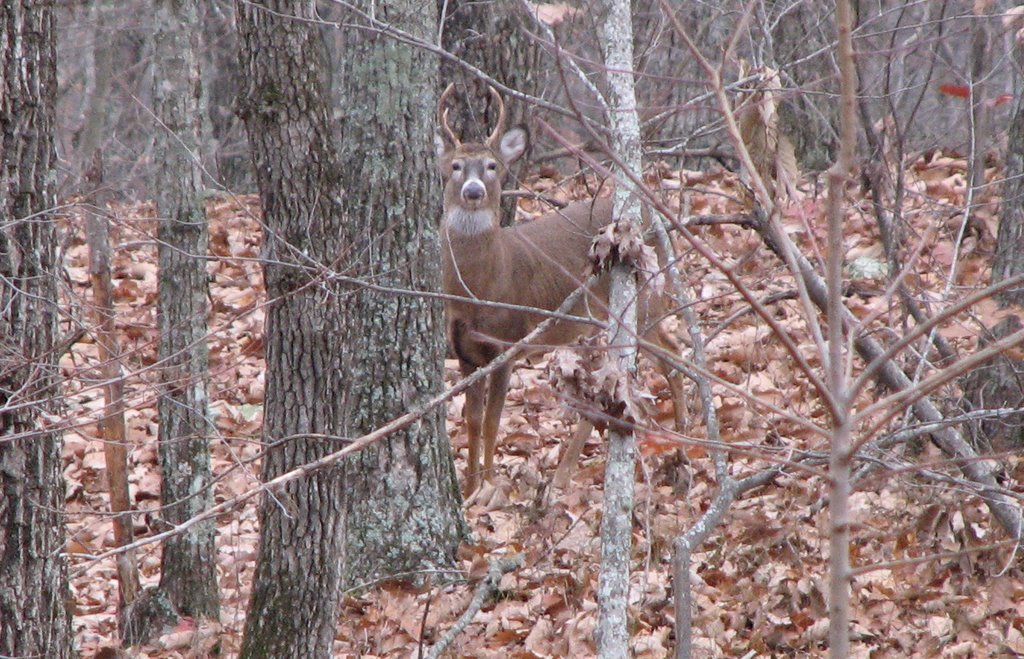
Tthis picture was taken about a week ago while hiking in the woods near my house. It is a buck but I couldn't tell how many points. Not too many, probably about 4, is my guess. This picture was taken a few days before the beginning of deer season in Tennessee. But if he stays in the Fairfield Glade area this deer should be relatively safe. I say "relatively" because even though hunting is prohibited in Fairfield Glade, there are a few local Tennessee boys who have been known to try to shoot a deer along the roads from their car.

Last winter I found a few strands of deer hair and some blood on the road not far from my house. I called the local police because they had told me previously that they were trying to catch a poacher who would drive the roads and shoot from his truck (a grey GMC). I thought that I was Mr. CSI Tennessee (Crime Scene Investigator). But the officer told me that it was a police car that collided with the deer and not a shooting. It's kind of ironic that the police trying to stop a poacher from killing deer would run over one with their cruiser. Life is tough for a deer.

Thursday, November 16, 2006

Tennessee License Plates

We moved here from Texas where, as far as I know, there is only one license plate. At least that is all that I ever remember seeing. You could get personalized plates, but except for the letters and numbers, they all had the same design.

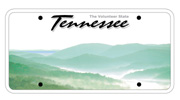
The picture of the new for 2006 Tennessee plate was my first ever posting on this blog. This plate is beautiful. It looks just like the mountains around here....that is until the numbers and letters are added. Then the mountain layers are obscured and you can't tell what the picture is.

However, if you don't like the new standard plate don't dispair. By my count you have up to 116 other choices...not counting personalization of the letters and numbers. There are 13 different plate designs for Club/Groups, 42 for Colleges, 22 for Military, 32 Miscellaneous, 5 for emergency personnel, 2 for the disabled, and finally 1 for the Tennessee Titans. (there are at least 5 for the University of Tennesse Volunteers)

Even though the speciality plates cost more than the standard plates, the extra cost usually goes to support the subject of the plate. For example the extra cost of the Bear Plate on my car goes to support the species and the enhancement of their habitat. Cool!

Nancy's car has the Bluebird Plate. The extra cost for this plate goes for the protection of non-game species.

If you live in Tennessee you can go to this site Tennessee License Plates to view your options.

If you like choices and you like to support some cause through your license plate and your contribution, then this is the state for you. Happy motoring.

Sunday, November 12, 2006

2 Days in the Smoky Mountains

Here we are in the Great Smoky Mountains National Park for 2 days of hiking with the Fairfield Glade Hiking Club.

The weather was perfect! It was in the 70's both days and that is about as good as it gets this time of year in the mountains. 34 of us traveled the 90 miles to GSMNP on Thursday morning. The first day, we hiked 5.1 miles on a 3 trail loop.

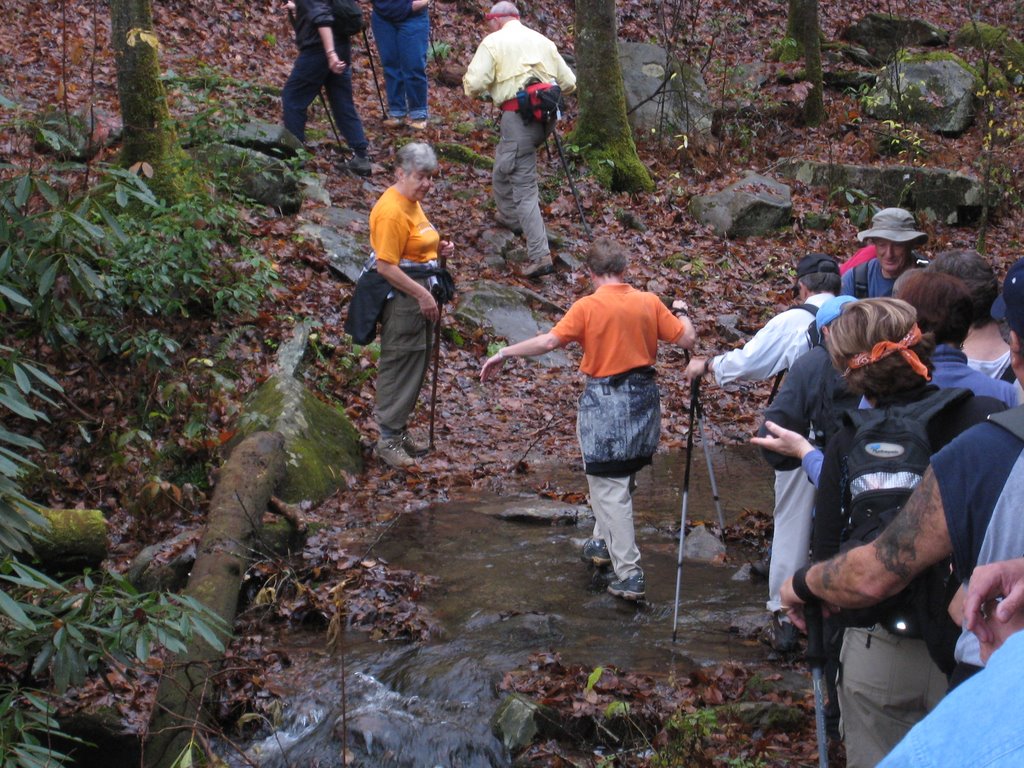
As you can see in this photo, the streams were running higher than normal due to some recent rain. We had to build log bridges or wade at a couple of spots that we had just stepped over a couple of weeks earlier.


This picture is along the trail the 2nd day. This hike was 6.1 miles long. It was also the combination of 3 different trails. Near the end of the trail at a graveyard near the Great Smoky Mountains Institute at Tremont, Bob Callis gave us a little history lesson about the early part of the century (the last century, not this one).

You might have to click on this last photo to get a better view. This was taken in Cades Cove after the hike. Cades Cove is a flat valley in the heart of the Smokys that at one time was where most to the settlers and farmers lived in these mountains. Today, Cades Cove has an 11 mile driving loop where we have often seen bears and deer. However. the animals in this picture are horses.

Monday, October 30, 2006

Pictures

Over the past several weeks we have had visitors and then we traveled up to Indiana and to Pennsylvania and then back to Tennessee over a 5 day period. But now we are back in town for awhile. I like to post something about once a week and I did have a couple of nice pictures from close to home (actually both of these pictures were taken from my house). This first one is looking out our back windows. This picture was taken with a 12x telephoto so the hills show a little closer than usual. Those hills are really about 6 miles away and they always look different depending on the fog, or haze, or sun or time of day. This one was taken in the early morning. I like the layered look.

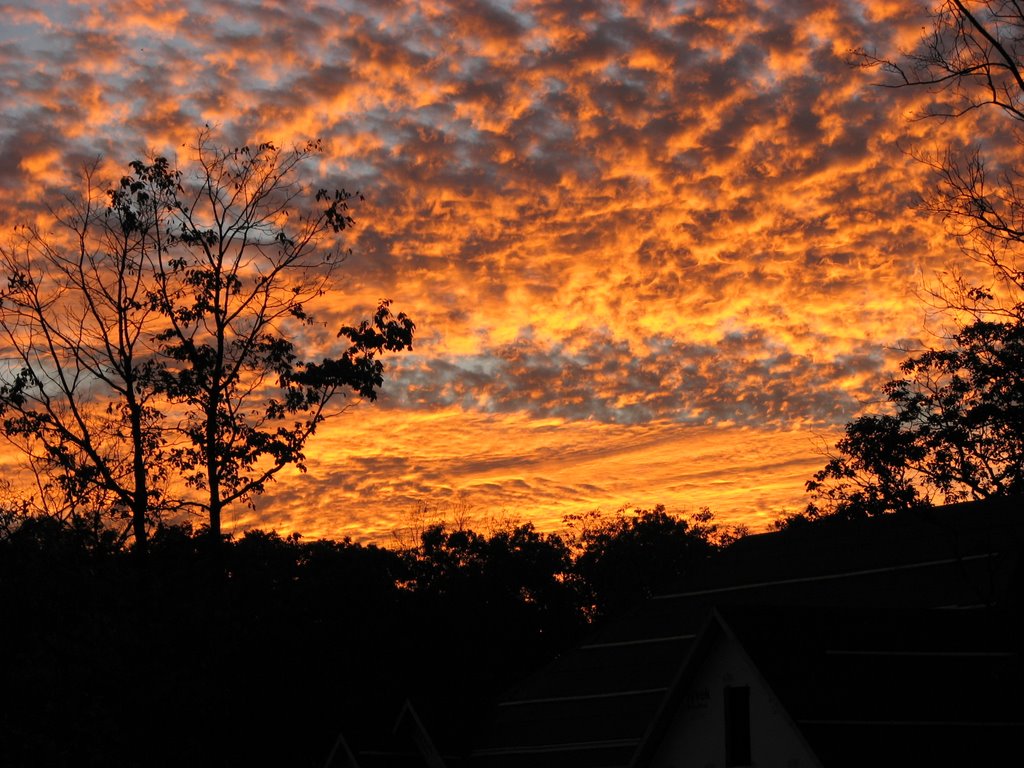
This picture was a sunset about a week ago. It was taken out the front of the house.

By the way, if you are planning to buy a new digital camera, I have a good recommendation for you. I like Canon cameras for two reasons. First they rate very high in Consumer Reports (but then again so do several other brands). Secondly, our first digital camera was a Canon and I liked it alot. But it was 5 or 6 years old and only 2 megapixls so I needed to upgrade. I bought one camera (a Canon S3 IS) with a 12x telephoto for animals and long shots, and another (a Canon SD 800 IS) that is very small for taking hiking, etc.

But my recommendation is not on the camera...you will need to decide what works best for you. My recommendation is on where to buy it. Once you figure out what camera you want, go to Beach Camera. The advantage of Beach Camera is 1) Oustanding customer rating, 2) Much lower prices than stores like Circuit City or Best Buy, 3)No tax, 4)No shipping charges.

I ordered one camera on a Thursday online and it was delivered on Saturday afternoon by Federal Express. The other one took 3 days. But the main thing was the substantial price savings. Now if I can only get though the 124 page instruction manuals I can take advantage of everything that these new cameras can do. Wish me luck!

Thursday, October 19, 2006

Ladybug Beetles

Wow, there has been a Ladybug explosion! Here in Fairfield Glade and also in many other places across the country, all of the sudden, Ladybugs are everywhere. On the windows, in the garage, in the house, and especially on hole 13 on the Crag Course at Heatherhurst Golf Club here in Tennessee. What is going on?

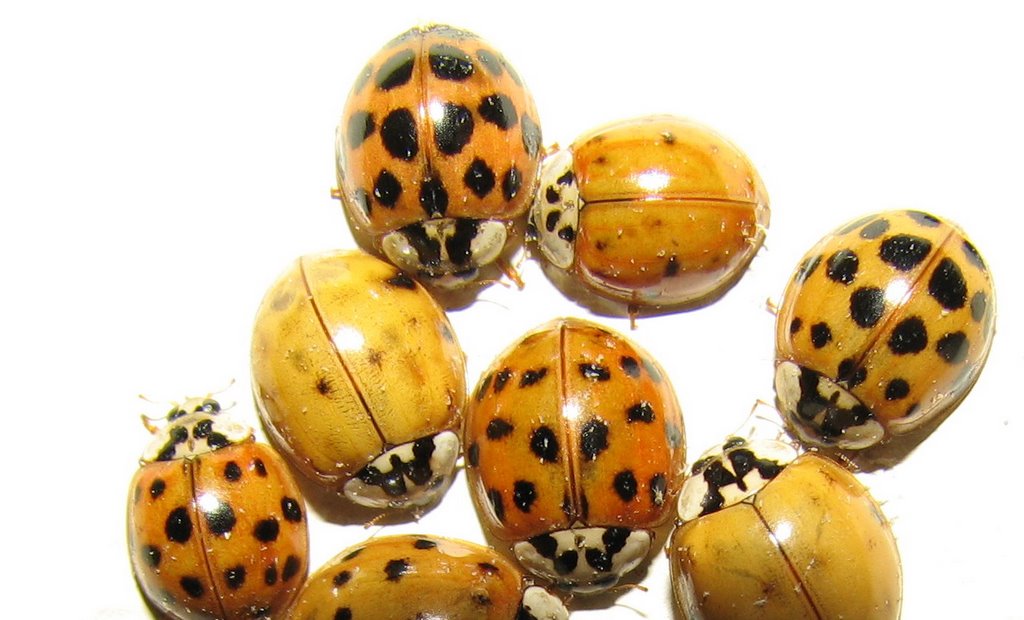
Well, it is a natural phenomenom and it is harmless. These Ladybug Beetles are specifically called Convergent Ladybug Beetles. They are good insects. Both the adults, pictured here, and the larvae eat aphids and scale insects which can damage plants. The Ladybug beetles are harmless to plants and humans, except that they sometimes can transmit a fungus that is harmful to Dogwood trees.

The beetles come in various shades of red and orange, with black spots.
They are here all year, it is just that this time of year the beetles quit eating and begin to cluster into large groups that will hibernate together over the winter.
Someone told me that they stain your walls and stink if you smash them. I wouldn't know because I didn't, and I don't, plan to crush any. But it makes sense because the Ladybugs have a foul tasting chemical in their leg joints that is their defense against being eaten. It is kind of like the skunk factor. You may tangle with one once, but you will avoid them going forward. Birds leave the beetles alone either because they tried one themself once, or because the birds are DNA programmed to avoid them.

So, just swish your Ladybug Beetles away and sit back and enjoy nature. If we are lucky they will be back again next fall.

Monday, October 16, 2006

New Camera

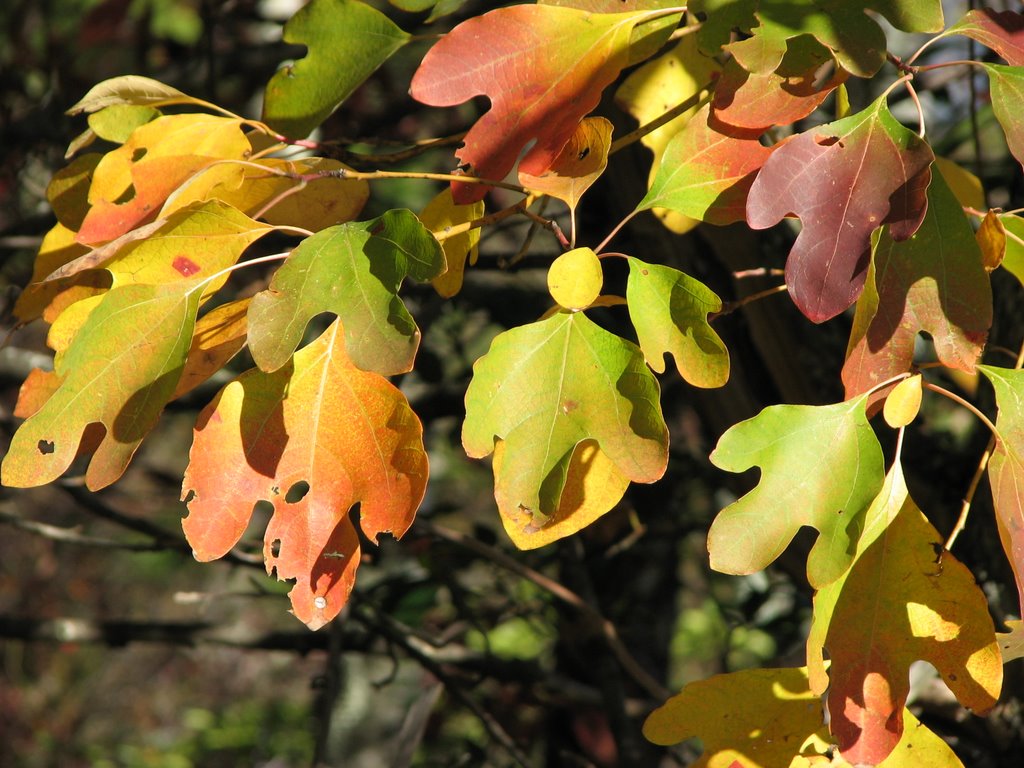
Well, here is one of the first pictures from my new camera. These are the leaves from a Sassafras Tree beginning to show their fall colors. The leaves around here are probably 2/3 of their way to full color.

My old camera was a Canon, about 6 years old, and it took some great pictures. But there were a couple of problems. First, it was only 2 megapixels, which means (as I understand it) that if I decided to blow any pictures up to 8 by 10 or bigger that the pixels might start to show. I have been looking for some great landscape pictures from this part of the country, particularly the Smokys, to mat, frame, and hang in our house. I have determined that I might be able to take some of them myself, but with just a 2.0 pixel camera I couldn't blow them up very large. Second, the optical telephoto on my old camera was only 3X. That made it hard to get close pictures of animals. My new Canon S3 IS with 6 megapixels, 12X telephoto and image stabilization will solve those problems. Plus, my old camera didn't have a Macro setting. When I tried to take a picture of a pea sized Black Widow Spider all I got was a black dot. The new camera can get as close as the lens touching the object.

This picture of some yellow wild flowers is an example of getting close. If you click on the photo to see a full size view, you can see the drops of water on the petals. In fact, I just discovered that if you click, wait for the picture to enlarge, and then click again, you get an even bigger, closer picture. Try it.

My neighbors are once again questioning my sanity when they see me kneeling in their yards to take a picture of a blade of grass. I thought that explaining the new camera and the up close Macro function might keep them from calling the guys in the white coats again.

Tuesday, October 10, 2006

Smoky Mountain Pre-hike

What is a pre-hike you ask? Let me explain. On November 9 & 10 our Fairfield Glade hiking club is going to the Great Smoky Mountains National Park for 2 days of hiking. Normally we hike on Fridays, but once in a while we do a 2-day overnight hike. We will stay in motels and eat dinner in restaurants, but hike 2 consecutive days in an area a little further away than normal.

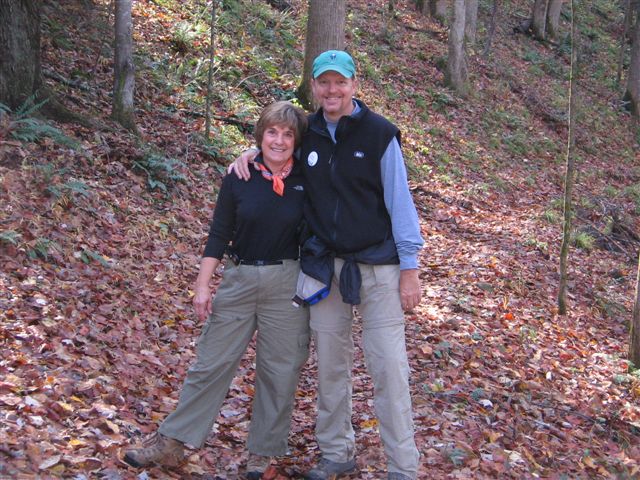
Nancy and I, along with Ray and Marion Miner are in charge of this particular 2 days of hiking. So prior to November 9 we have to pre-hike the trails to make sure that the length and difficulty are appropriate for the club. That's Nancy looking cute during a short rest on the trail.

Yesterday, 7 of us drove to the Smokys and hiked 7.1 miles on a 3 trail loop. We determined that the hike is probably not a good one for the club for 2 reasons: length and difficulty. A group of people hiking together is like that saying about a chain being only as strong as its weakest link. A hiking group is only as fast as its slowest hiker. The first 1.8 miles of yesterday's hike was straight uphill for about 1,500 vertical feet. The next 5.3 miles back to the trailhead was much easier but the total hike took us almost 5 hours. A larger group would hike slower and stop more often. So we found a way to do a 5 mile hike on some of the same trails but without the 1.8 uphill in the beginning. It will take a car shuttle, but that will work OK.

We had pre-hiked another 5.4 mile loop trail 2 weeks ago and that one will be fine for the group.

But be warned! If you plan to visit the GSMNP in the next couple of weeks be prepared for traffic. Two weeks ago when we were there hardly anyone was in the park. Yesterday we could hardly get across the road to get to the trailhead. There was a steady stream of cars. As you can see from the top photo the leaves are just barely starting to change on the higher elevations. The leaves should be extraordinary in a few weeks, but then again so should the traffic.

Wednesday, October 04, 2006

Tennessee Browns

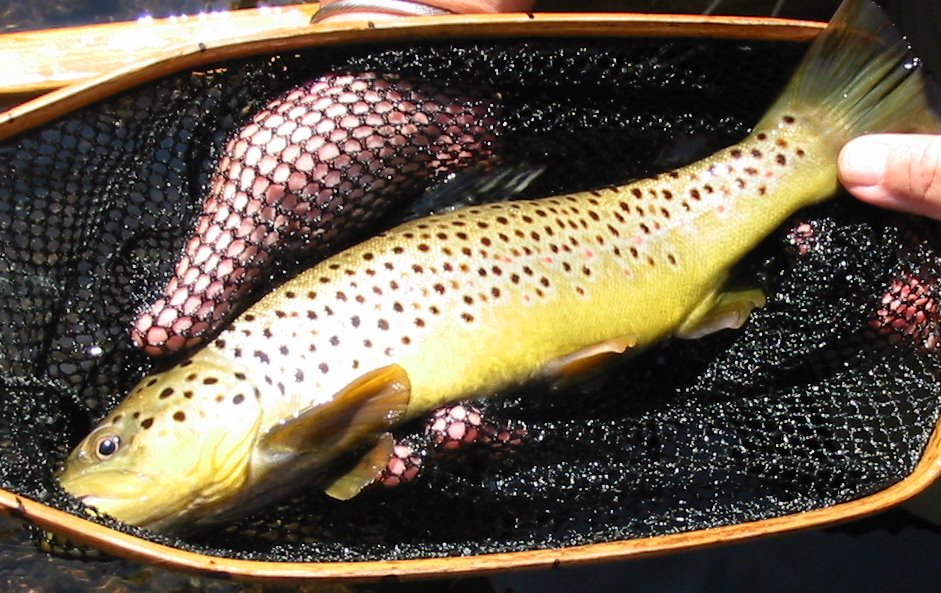
Ray and I took a little fishing trip today to the Elk River near Lynchburg Tennessee. Lynchburg is famous around the world as the home to the Jack Daniels distillery and Jack Daniels whiskey. We liked it better for the trout. That is a 14 inch Brown Trout in the picture.

The Elk River is a tailwater coming out of Tim's Ford dam. In fact, we fished nearly in the shadow of the dam. That can be a little tricky because, like most tailwater streams, the turbines could be started up at anytime and the water level will quickly go from calm and smooth to wild and dangerous. Supposedly, there is a siren to warm those downstream that the water is about to rise quickly and high. We had called ahead and got the generating schedule and it was supposed to be quiet all day....but then again, you have to always be on the alert for rising water.

Here is another smaller Brown Trout that I caught. Most of the fish we caught were Rainbows, but I did catch 3 or 4 Browns.

The Elk is a fairly small stream as tailwaters go....not too deep and easy to wade. We only saw about 4 or 5 other fishermen all day. One man that I talked to on the river said that this stream is never crowded, but it always fishes well. We caught fish steadily all day, mostly on nymphs (especially my favorite Gold Ribbed Hare's Ear that I tie myself) but I did get one nice Brown on an Elk Hair Caddis dry fly. That seemed appropriate for the Elk River.

Saturday, September 30, 2006

Smoky Mountain Bears

The picture is a little blury. It may be because the bear was running or maybe it is because the photographer was shaking. I kind of think that many wild bear pictures might be blury.

This is a Black Bear in the Cades Cove section of the Great Smoky Mountains National Park (GSMNP). We went to the Smokys with Ted and Sherry Crawford of Johnstown PA. Sherry took this photo. I am sure that Sherry was steady, but the bear was moving. This is one of 6 bears that we saw last Tuesday. There are estimated to be about 1,700 bears in the park.

We first saw one bear in the woods beside the road. There was a "bear jam" which is a traffic jam in the GSMNP due to the spotting of a bear. There were 20 people out of their cars looking at the bear, some as close as 15 yards away. The bear was grazing on acorns in the woods. It obviously knew the people were there but it ignored them. A year or two ago a black bear killed a woman right near one of the streams that we normally fish not far from here. Usually the bears are not a threat to humans, but I wouldn't let my 5 year old kids get within 20 yards like some people did.

A little further down the road we saw the bear in the picture. It was the biggest of 4 bears travelling together. It appeared to be a mother with last years cubs. I believe that black bears only have cubs every other year. This bear actually charged a couple of people taking pictures who only had a barbed wire fence between them and the bear. Sherry got the picture as the bear retreated after the charge. Most charges are just a bluff to let someone know that they are getting too close.

This bear then joined the 3 smaller ones and together they moved to a very large oak tree in the middle of a field. Three deer ran from the field, stopping to look back at the bears every so often. All 4 bears climbed to the smallest outer branches of the tree and stripped acorns from the branches. We watched them for 20 minutes until the light started to fade. It was amazing how agile the bears were in the tree. They climbed straight up the broad trunk just like a cat might. They stood on one leg and reached out to the smallest branches for acorns. Three weeks ago we saw bears in the wild cherry trees in the park doing the same climbing for cherries.

A few minutes later we saw another very large bear grazing for acorns under another oak tree in a field.
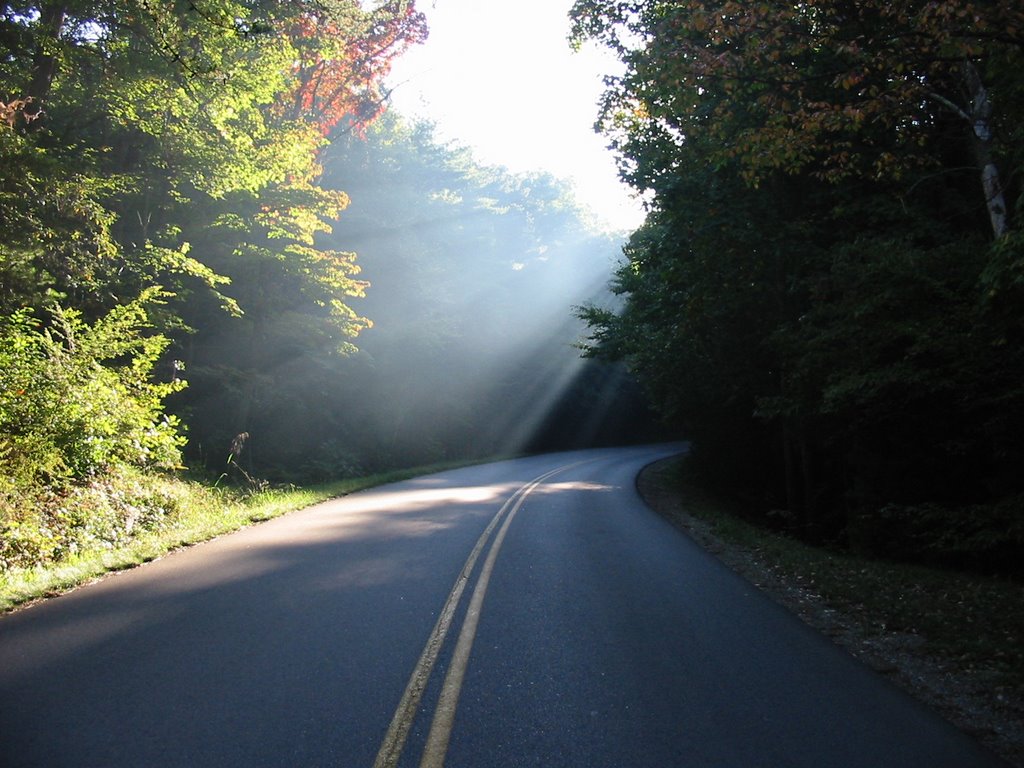
This last photo has nothing to do with the bears. It is just a picture of the sun shinning down through the trees as we were leaving the Cades Cove area on Wednesday. It was a great time to visit the Smokys. The weather was crisp and cool and the park wasn't jammed up with leaf lookers. October is the second most busy month in the park after July.
Don't forget you can click on the pictures for a bigger view.

Friday, September 29, 2006

Smoky Mountain Views

We took a 2-day trip to the Smokys this week with my nephew Ted Crawford and his wife Sherry. The mountains are beautiful.

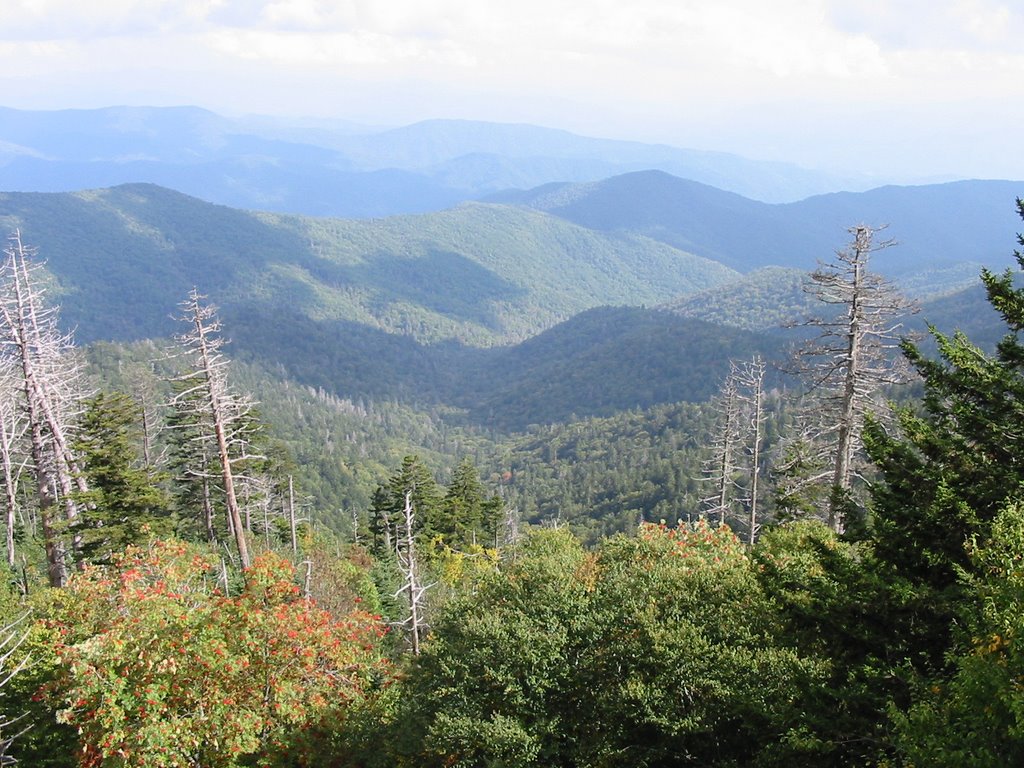
We did the usual stuff like visiting Clingman's dome, the highest point in the park. The views from Clingman's Dome are excellent. That is, they are if the weather and visability cooperate. We had a little bit of fog and some haze, but not bad. At left is a view looking down on some mountains with cloud shadows.

Another great stop is the Sugarlands visitor center. It has very informative displays and a very nice gift shop. There are rangers on hand to answer any questions you may have and to give informal demonstrations and talks.

We hiked a little over 5 miles on a back country trail. There were specific bear warning signs for our trail. A ranger said that a bear had been confronting hikers by standing up on its hind legs and growling, just like on TV. We didn't see that bear. It probably knew not to mess with us.

We also did the loop drive around Cades Cove. We have always had great luck seeing wildlife on the Cades Cove trip. At left is one of the deer that we saw. As you can see, Cades Cove is a large flat bowl. It is only about 1,500 feet elevation and it is surrounded by 4,5,and 6 thousand foot mountains. This is the area that was farmed in the early 1900's. The park still mows and burns it on a regular basis, to keep it like it was in the early part of the century and probably to make it easier to see wildlife. Cades Cove is like a drive through an animal park except that the animals here are wild and are not fenced in.

Oh, did we see any bears? Yes we did! More on that in the next posting. My camera was acting up in the zoom mode so I am waiting for the great shot that Sherry got to show the picture and tell the story.

Friday, September 22, 2006

Black Mountain Chain Gang

Well, not really a chain gang....but we worked like one. This is about 1/4 of the members of the Fairfield Glade Hiking Club that participated in trail maintenance at Black Mountain today.

Black Mountain is only about 10 miles from our house. At 2828 feet, it is one of the taller peaks on the plateau. On a clear day you can see for many miles in all directions. When we were there last spring we could see the Smoky Mountains 75 miles away. At over 6,600 feet, the Smokys towered above our little peaks on the plateau.

Our club is the official guardian of the Black Mountain portion of the Cumberland Trail which traverses Tennessee. Friday is our normal hiking day, but today instead of hiking we worked on the trail.

It sounds a lot more glamorous than it is. Trail building and maintenance always sounded like an exciting outdoorsy type of thing to do. I even considered signing up for a week of this manual labor on the Appalachian Trail. I am sure glad that I didn't! Two hours of using a fire rake, or a McCloud (all-purpose chopper-raker kind of thing) and I was glad it started raining.

The goal is to create or maintain a corridor 4 feet wide by 8 feet high. We did that! In the process we pruned limbs, chopped out roots, and dug out some rocks on the trail. In real trail work you also dig down through any topsoil to the "mineral soil" which is a lighter color. Plants do not grow as easily in the mineral soil so the trail is less likely to grow over as soon. Our mostly retired hiking club didn't have enough muscle power to dig down to the mineral soil. But we all did our jobs of raking, chopping, pruning, etc. and the trail looked like a boulevard. It wasn't much, but every little bit helps. By the way, that is Nancy in the middle of the picture with her round white name badge.

Monday, September 18, 2006

A Toad on the Road

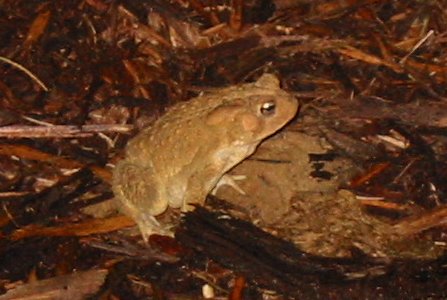
If you drive around here at all at night you will often see lots of toads on the road...all sizes. I think that most of them are the Eastern American Toads. Fowler Toads are also found around here, but every one that I checked out was an American Toad.

We also often have toads on our driveway. The one in this picture hopped into the mulch near the driveway for his portrait. We have a light out by the mailbox and three lights on the garage. These lights attract insects and the insects attract the toads. Once, a few years ago when the June Bugs were especially abundant, several toads would gather under the street light near our house and gorge themselves on the June Bugs. I picked one up and you could feel all the June Bugs in its stomach.

I think the toads like the roads because the roads warm up during the day and probably hold the heat a little after the air cools down. Toads are cold blooded like snakes and they have to get their warmth where they can find it.

And, speaking of snakes, there is a snake around here that is a toad specialist. The Eastern Hog-nosed snake feeds almost entirely on toads. Good for them because toads probably aren't too tasty. If you have ever picked up a toad you will know that the first thing a toad does when picked up is pee all over your hand. They also have a secretion from a gland behind each eye that will irritate your eyes and nose if you let it touch those areas. But, thank goodness, since the toad just got done peeing on you I'll bet you do a pretty good job of keeping you hands away from your mouth and eyes. Contrary to that old tale, toads do not give you warts. But then you knew that.

I haven't seen a Hog-nosed snake around here yet but Nancy and I did see one in the Palo Duro Canyon in Texas a few years ago. As we were hiking a trail we met several people coming the other way and telling us that there was a Rattlesnake up ahead on the trail. Well, when we got there it was a Hog-nosed snake, not a Rattlesnake. Hog-nosed snakes hiss and act aggressively until that act doesn't work and then they play dead. I just eased it off the trail and we hiked on. But, seeing that snake had Nancy on high alert. A few minutes later a bike rider came up behind us and when he said "pardon me, can I pass" Nancy jumped about 3 feet and screamed. She was thinking nothing but "snake" and any sound behind her at that point was more than a snake-a-phobe could handle. That snake wouldn't hurt us. He was just looking for a toad on the road.

Thursday, September 14, 2006

Smoky Mountain Fly Fishing

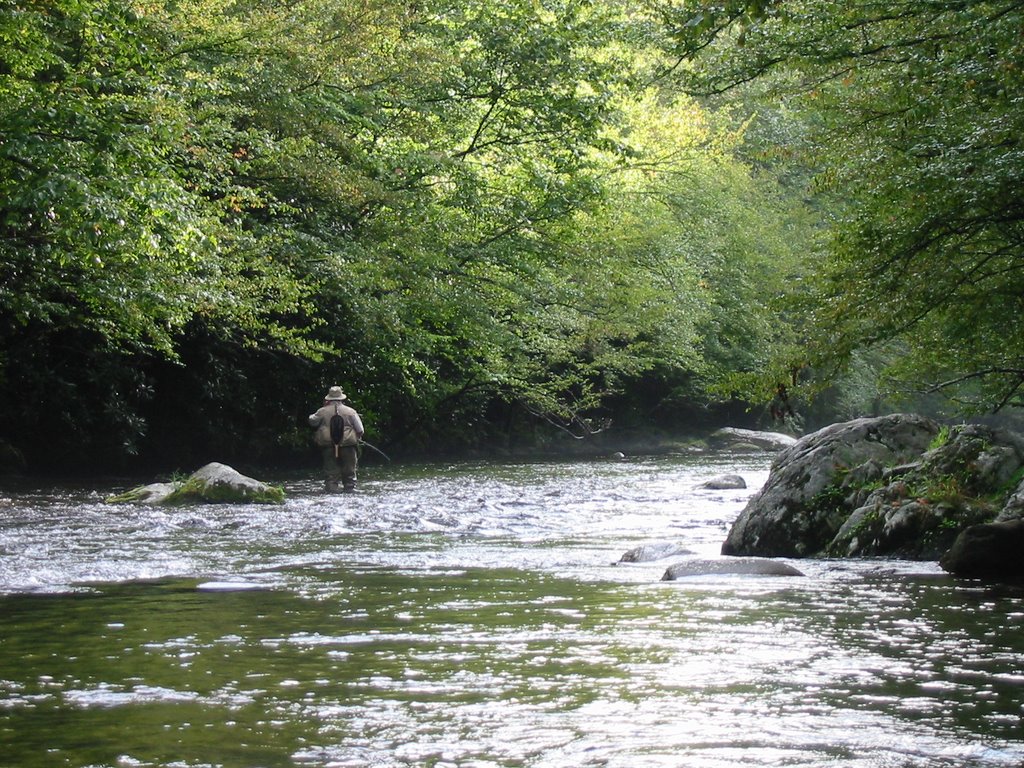
There is nothing more beautiful than fly fishing in the Smoky Mountains. The scenery is great and the fish are all wild - no stocked fish. At left is my fly fishing buddy Ray on the Little River in the Great Smoky Mountains National Park. The Little River is listed in "Trout Unlimited's Guide to America's 100 Best Trout Streams".

We went for a 2-day trip for two purposes: 1) do some fly fishing, and 2) pre-screen some trails for an upcoming Fairfield Glade Hiking Club trip. We never got around to item number 2 - we will have to go back.

The fly shop web site had been saying that the fishing has been excellent lately. But that is not what we found the two days that we were there. Oh yeah, we caught some fish, but we really had to work hard to get them. I think that we caught about 14 between us. We tried 4 different streams and numerous flys, both drys and nymphs. I read the fly shop fishing report when I got home and it said that fishing was very very slow while we were there. Other fishermen were reporting few or no fish caught. So, it wasn't just us.

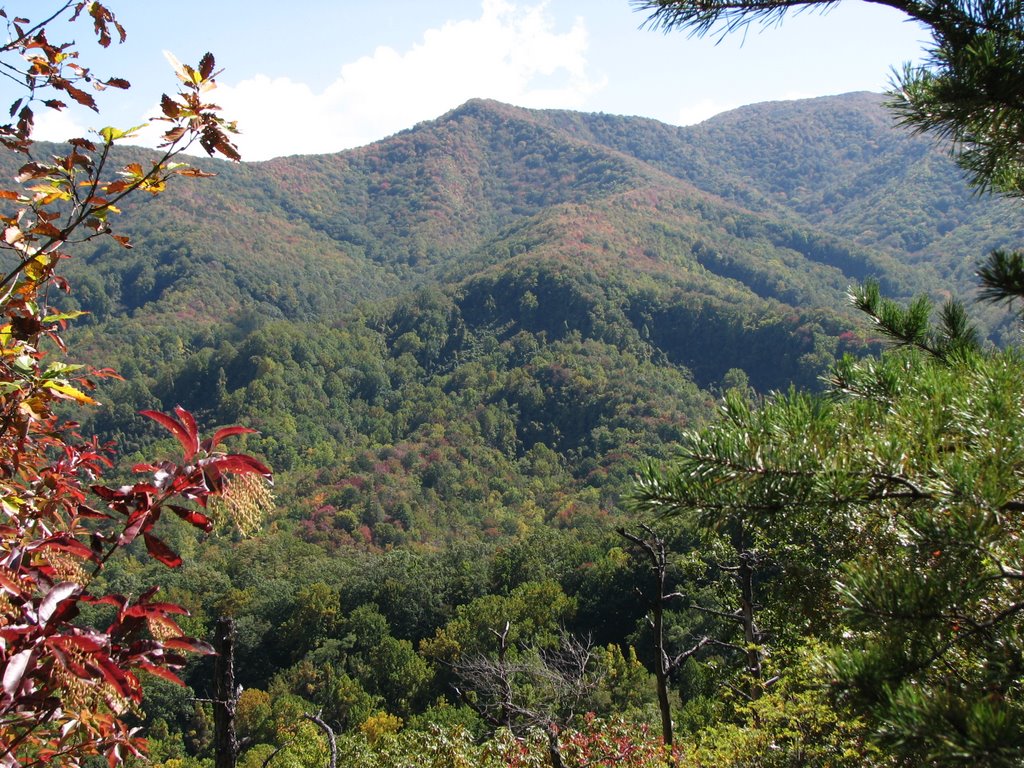
As you can see from the pictures the Park was beautiful. The mornings were cool and the daytime temperatures perfect. The leaves haven't started to change color yet, so the number of visitors in the Park was manageable. I understand that once the leaves start to change that a fair portion of the 9 million annual visitors shows up. The GSMNP is the most visited National Park in the country.

We talked to two people who ran into 2 bears on one of the trails and backed off the trail to give the bears room. The bears moved on when they saw the people. That is the way is usually works. Another place there was a sign at a trailhead that warned of an aggressive bear on that trail. A ranger told me that probably someone fed the bear and it lost its fear of humans. That always spells more problems for the bear than it does for people. The rule is: If a bear ever becomes aggressive towards humans and it continues, the bear is darted and moved. If a bear ever makes contact with a human the bear is killed. Signs in the Park say "A fed bear is a dead bear" So don't feed the bears.